A mandate map shows team gaps and overlaps. This example is invented.
Incidents under NIS2
Late on a Friday, Security sees someone trying to get into the system that runs production, and can’t yet tell whether they got in. Security thinks it is for Compliance to judge whether it has to be reported, so it waits. Compliance can’t judge before Security says what happened, so it waits too. On Monday it turns out they got in, and the early warning goes out three days after Security first saw the attempt.
You lead the company’s NIS2 work and sit in neither team. In Monday’s meeting each team explains why it waited for the other. You want the next attempt assessed the night it happens.
Three responsibilities between Security and Compliance
You create a map for Security and Compliance and write down each piece of work they share: deciding whether an incident is significant, sending the early warning within 24 hours, and telling management about a significant incident. For each one you propose an owner and how far the mandate goes: Security decides on the first after consulting Compliance, Compliance sends the early warning, and Security tells management.
Each team’s answer
You invite people from both teams into your company’s atlas, the place in Reimagine where its maps are kept. Compliance agrees with your proposal for the first responsibility; Security answers that Compliance decides. Each team names the other as the one who decides, and the responsibility is marked Contested. Both teams agree on the early warning and on telling management.
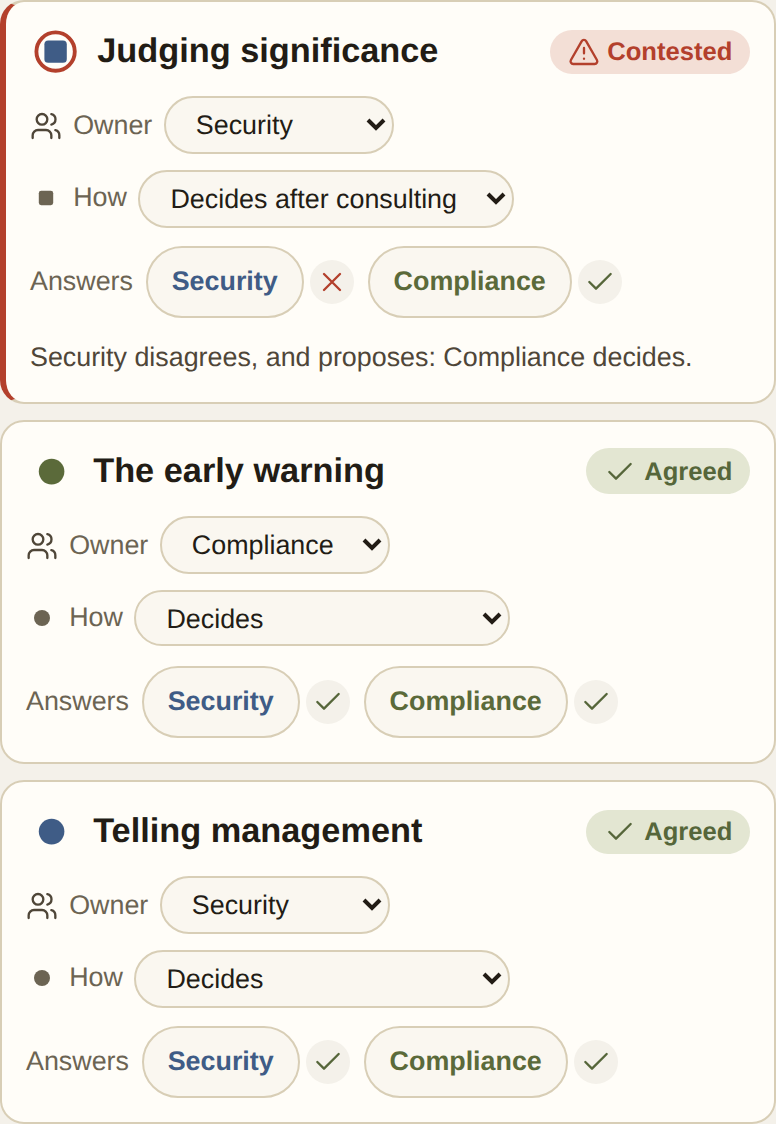
Who decides whether an incident is significant
You put the map on a shared screen, with each team’s position but not who answered, and ask who should judge whether an incident is significant, Security or Compliance. Compliance answers that it can’t judge until Security has said what happened. The teams agree that Security decides alone and tells Compliance the same night. You change the responsibility, both teams answer again, and it is agreed. Saved as a PDF, the map goes into the NIS2 documentation.
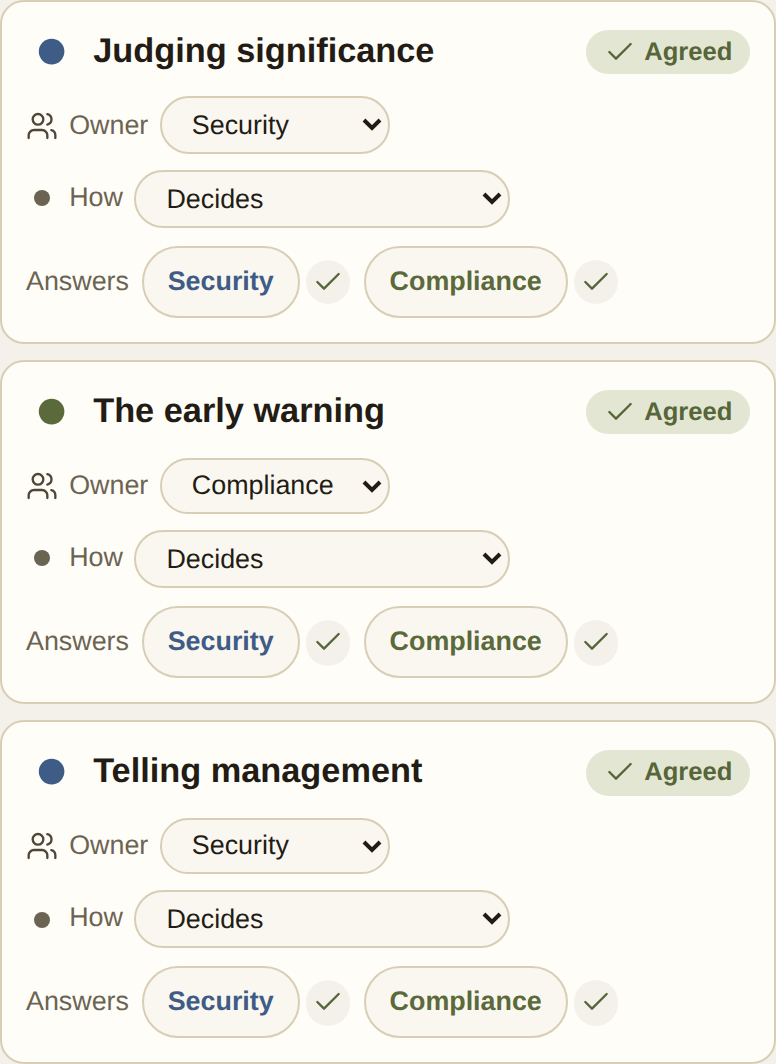
As the map says, Security decides the same night whether the next attempt is a significant incident, and tells Compliance.
The template for incidents under NIS2 has these three responsibilities already written, among nine for Security, Compliance and IT Operations.
You make a map like this one in Reimagine, in your browser, and each team answers there. While Reimagine is a preview, access is by invitation and free. When you ask, Reimagine writes to you once you can create your company’s atlas, and the atlas starts with a sample map you can try before you invite anyone.